
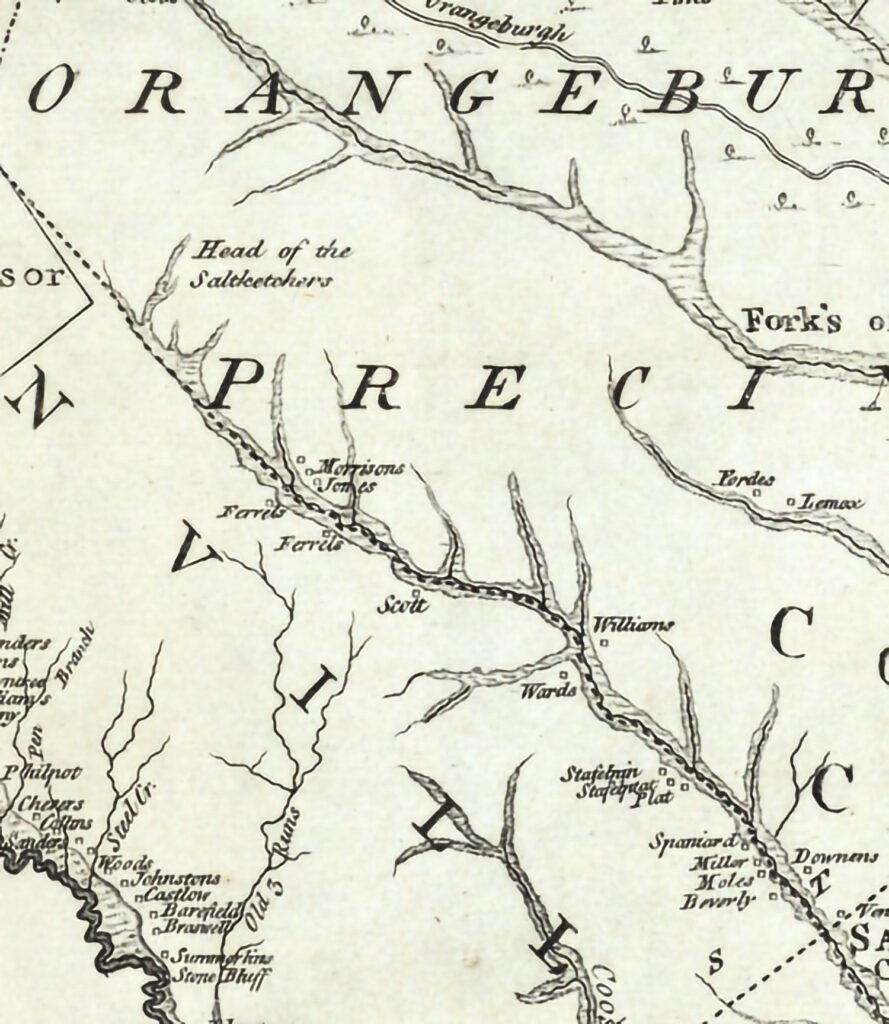
River between Turkey Creek and Toby’s Creek. The nearby ford across the river became
known as Morris Ford.
In the spring of 1780, after the British had captured Charlestown , Captain John Mumford led a group of men who had escaped and were making their way inland to join forces with other patriots in South Carolina. Mumford’s plans are lost to history, for he and his men encountered a band of Tories led by Old Ben John at a crossing of the Salketchers River known as Morris Ford, named for the family of Thomas Morris, Sr., who lived nearby. A sharp skirmish ensued and the patriots were defeated.
According to Tarlton Brown’s memoirs, published in 1843, Captain Mumford was killed at Morris Ford and buried beneath a large pine tree near the turn of the road leading to the ford.
The remains of a portion of the Morris Ford earthworks, along with a memorial marker for Mumford can be seen alongside the Old Allendale Highway, two miles south of Barnwell, South Carolina. An historical marker placed by the Barnwell County Museum and Historical Board describes the Revolutionary War action at Morris Ford as well as the American Civil War skirmish where Confederate troops faced Union General Judson Kilpatrick’s cavalry.
Local landowners say that at least half of the original earthworks were destroyed when the railroad trestle and modern road near the ford was constructed.
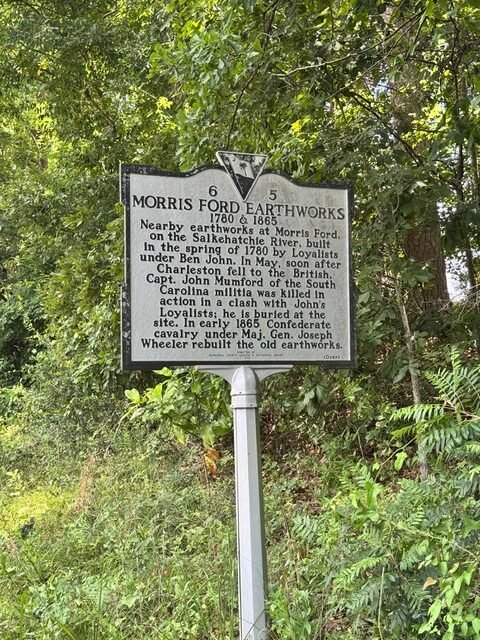
This Historical Site Marker Reads, ” Nearby earthworks at Morris Ford, on the Salkehatchie River, built in the spring 1780 by Loyalists under Ben John. In May, soon after Charleston fell to the British, Capt. John Mumford of the South Carolina militia was killed in action in a clash with John’s Loyalists; he is buried at the site. In early 1865 Confederate cavalry under Maj. Joseph Wheeler rebuilt the old earthworks. (Front)
Wheeler delayed the advancing Federal cavalry under Brig. Gen. Judson Kilpatrick. On February 6th a sharp skirmish occurred at the works. Elements of Kilpatrick’s crossed downstream, outflanked the Confederate cavalry and forced it to withdraw, then advanced to Barnwell while Wheeler’s cavalry withdrew toward Aiken. Kilpatrick’s Federals burned most of Barnwell later that night. (Back)